
Glass Skin in Korea: What a Dermatologist Actually Does to Get You There

What "glass skin" really means (and what it doesn't)
Hello, I'm Dr. Min Jeong, and I've spent years helping international patients chase what the internet calls "glass skin." Before you book anything in Seoul, I'd gently ask you to read to the end — because the biggest reason people feel they "wasted money" is that they bought a single trendy treatment when their skin needed something else entirely.
So let's define it honestly. Glass skin isn't a product or one machine. It's a look: skin that appears smooth, evenly toned, genuinely hydrated, and luminous enough to catch light like a pane of glass. That look comes from three things happening at once — refined pores and texture, calm and even tone, and healthy hydration. When international patients ask me for glass skin in Korea, my job is to figure out which of those three your skin is missing, rather than assume it needs all of them.
Why the "one magic treatment" approach fails
I say this as someone who has personally placed thousands of injections and treated a lot of skin: the same treatment can be an excellent decision for one face and a waste for another. A patient with enlarged pores and dull texture needs a different plan than someone whose main issue is redness or uneven pigment.
That's why I run a diagnosis-first clinic. Glass skin is really a combination result, and the art is choosing the smallest effective combination — not stacking every device on the menu. Below are the pillars I actually work with, and who each one suits.
Pillar 1 — Texture and pores: a collagen booster, not a filler
If your skin looks rough, matte, or "grainy" up close, the foundation of a glass-skin plan is usually a collagen booster. My most-used tool here is Juvelook, a PDLLA collagen booster that stimulates your own collagen to refine pores, soften fine lines, improve texture, and restore a hydrated, glass-skin glow.
The key distinction I explain every day: this is not a filler. A filler instantly adds volume in one spot. A collagen booster asks your skin to rebuild itself, so the improvement develops gradually and naturally. REDI is a Juvelook Key Opinion Leader clinic with 15,000+ vials of hands-on experience, and I'll be honest about why that matters — the same product delivers very different results depending on the blend, the hydration protocol, and the injection technique. We match the delivery method (Dermashine Pro, Potenza, MIRAJET, and more) to your specific skin.
Realistic timeline: most people need about 3 sessions spaced roughly 4–6 weeks apart, with a maintenance touch-up every 6–12 months. Skin can look hydrated soon after, collagen-driven firmness appears from around 2–4 weeks, and fuller texture results develop over 3–6 months. Results vary by individual.
Pillar 2 — Even, calm tone: gentle toning
A luminous look falls apart if the tone is patchy from melasma, blemishes, or post-inflammatory marks. For this I lean on toning lasers such as Pico Toning and Laser Toning. These are designed to work gradually across several sessions rather than aggressively removing pigment in one go — which is exactly what you want for an even, natural finish with little to no downtime.
This is also where skin tone diversity matters. If you have a deeper complexion (Fitzpatrick IV–VI), pigment work should be conservative and staged, because overly aggressive settings carry a higher risk of rebound pigmentation on darker skin. I plan pigment treatments cautiously and confirm parameters after diagnosing your pigment type and depth.
Pillar 3 — Hydration and calm: soothing the barrier
The "glass" reflection people love comes largely from a healthy, hydrated skin barrier. For skin that reads tight, dull, or easily flushed, I use skin boosters like Rejuran Healer — a polynucleotide treatment derived from salmon that supports the skin's own recovery environment, helping with hydration, texture, and resilience.
For sensitive or reactive skin, soothing treatments such as LDM ultrasound can calm the skin and support its hydration environment with almost no downtime. When patients ask me "Juvelook or Rejuran?", my answer is simple: choose Juvelook to rebuild collagen and refine texture, choose Rejuran to repair and calm. They can also be combined — and for a true glass-skin plan, they often are.
A realistic timeline if you're flying to Korea
Because so many of my readers are planning a trip, here's how I typically map a glass-skin visit around downtime:
- Day 0 (treatment day): Skin boosters like Juvelook or Rejuran have minimal downtime. Expect mild redness, slight swelling, or small temporary bumps.
- Day 1–2: Most redness and small bumps from the boosters settle. Toning usually has little to no downtime.
- Week 1: Skin looks hydrated and settled; you're comfortable flying home.
- Weeks 2–4 onward: Collagen-driven firmness and glow begin to show, building over the following months.
If your plan includes a treatment with slightly more downtime, I'll tell you upfront and schedule it early in your stay. And because glass skin is usually a series, I'll set you up with online aftercare so we can follow up after you return home — you're never left guessing once you leave Seoul.
What to expect on the practical side
We have English- and Chinese-speaking interpreters on site, so you don't have to navigate a consultation alone — and you can message us on WhatsApp before you even book. I handle the consultation and the treatment myself, so the person diagnosing your skin is the person treating it. Airport pickup is available, and pricing is discussed transparently at your consultation once we've agreed on a plan. Glass-skin treatments are elective, non-insured aesthetic care, and I'll always aim for a result that reads as subtle and natural — luminous, not overdone.
Takeaways
- Glass skin is a combination result, not one treatment — smooth texture, even tone, and hydration working together.
- The foundation is usually a collagen booster like Juvelook (about 3 sessions, 4–6 weeks apart), which stimulates your own collagen rather than adding filler volume.
- Tone and hydration matter too: gentle picosecond toning for even color, Rejuran or soothing treatments for a calm, hydrated barrier.
- Downtime is generally minimal — often around 24 hours for boosters — which suits shorter trips; toning has little to none.
- Darker skin tones need conservative, staged pigment settings, which we confirm after diagnosis.
- I diagnose first and choose the smallest effective plan, then support you with online aftercare once you're home. Results vary by individual.
Frequently asked
What actually is "glass skin"?
It's a look — skin that appears smooth, evenly toned, well-hydrated, and luminous, so it reflects light like glass. It isn't a single treatment; it's the result of refined pores and texture, calm even tone, and good hydration working together. Results vary by individual.
Can one treatment give me glass skin?
Rarely. A glass-skin look usually comes from combining a few things — a collagen booster for pores and texture, gentle toning for even tone, and hydration or soothing. At REDI we diagnose your skin first, then plan the smallest effective combination.
How many sessions and how long until I see a difference?
With the Juvelook collagen booster, most people need about 3 sessions spaced roughly 4–6 weeks apart. Skin can look hydrated and radiant soon after, while collagen-driven firmness develops from about 2–4 weeks and fuller results over 3–6 months. Results vary by individual.
Is glass-skin treatment safe for darker skin tones?
Many of the tools we use — such as Rejuran, Juvelook, and picosecond toning — can be adapted across a range of Fitzpatrick skin types. For pigment and laser work on deeper tones we prioritize gentler, staged settings. We confirm your plan after diagnosis.
How much downtime should I plan if I'm flying in?
Skin boosters like Juvelook and Rejuran usually have minimal downtime — often around 24 hours, with mild redness or small temporary bumps settling within 1–2 days. Toning has little to none. We'll map a day-by-day plan around your trip.
Keep reading
More on this from Dr. Min Jeong.




Dr. Min Jeong
Founding director, REDI Dermatology · Seoul
“A treatment isn’t shopping. I’d rather diagnose first and recommend only what your skin genuinely needs — the same way I’d advise my own family.”
Board-certified dermatologist — trained at Kangbuk Samsung Hospital, and former Chief of Dermatology at the ROK Ministry of National Defense.
Recognized by VAIM as Korea's highest-volume Juvelook injector, with 15,000+ vials of hands-on experience; KOL for MIRAJET, Potenza and Oligio.
A regular speaker on clinical dermatology at Korean medical symposiums, including Juvelook clinical-experience panels.
Why international patients choose REDI
Interpreters in the room
English and Chinese, on site for your consultation and treatment.
Board-certified doctors only
Every procedure by a dermatology specialist — never unsupervised staff.
15,000+ Juvelook vials
Hands-on volume most clinics have not reached.
Airport pickup arranged
So your first day in Seoul isn't spent lost with luggage.
Aftercare once you're home
Online follow-up, so a question next week still reaches your doctor.
Explore the treatment
Juvelook Skin Booster
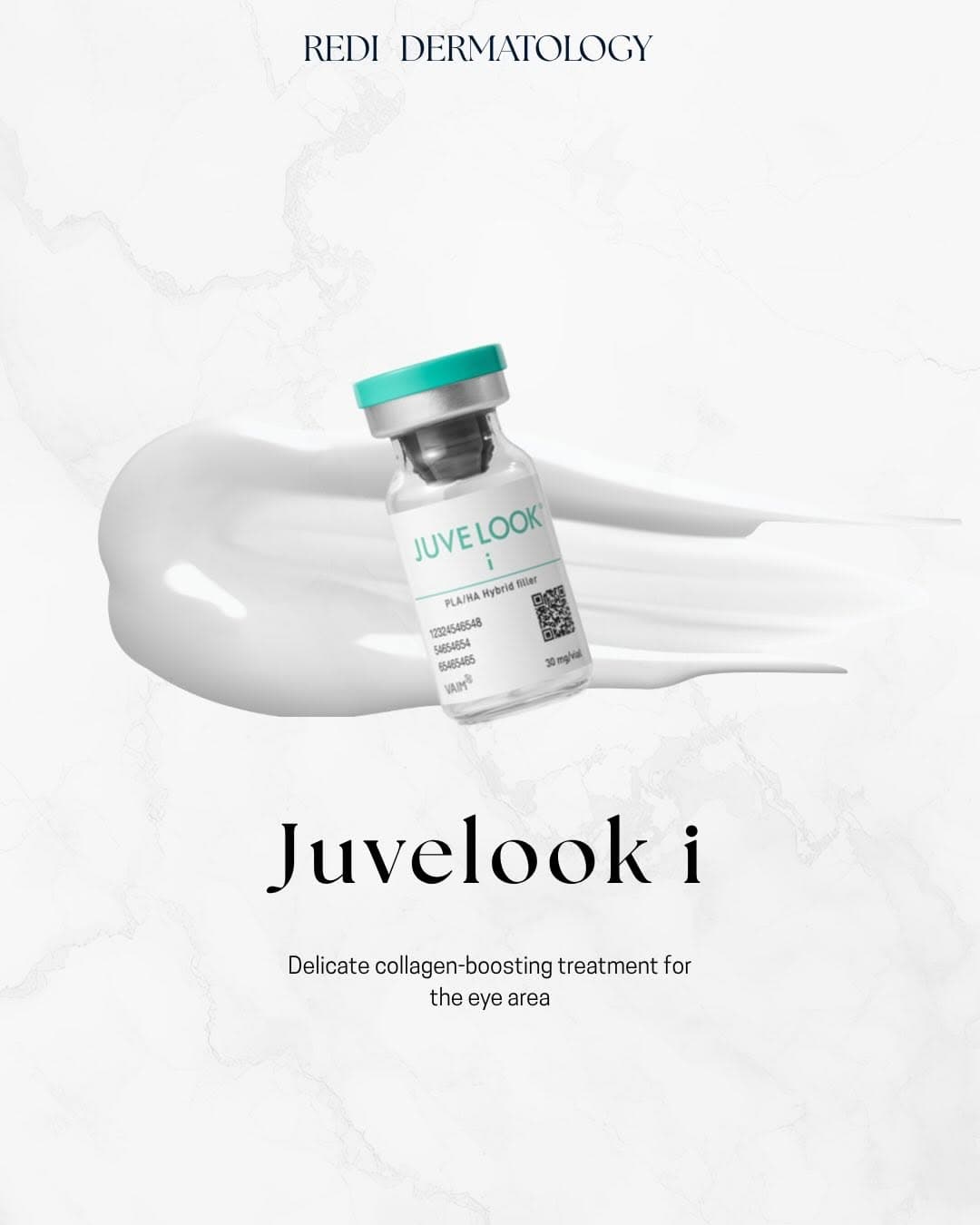
Juvelook is a PDLLA (poly-D,L-lactide) collagen booster that stimulates your skin's own collagen production to improve pores, firmness, fine lines, scars, and overall tone. Unlike a filler that simply adds volume, it helps the skin rebuild itself, so results develop naturally over time. At REDI, the blend and hydration protocol was refined by our Juvelook key doctor, and we match the delivery method — Dermashine Pro, Potenza, MIRAJET, Double Tite, and more — to your specific skin condition. With 15,000+ vials of hands-on experience, we know that the same product can deliver very different results depending on technique.
Rejuran Healer & Rejuran HB Plus
Rejuran Healer, a tissue-regenerating substance derived from salmon, is injected to effectively renew damaged skin. If you're sensitive to pain, Rejuran HB Plus — which contains lidocaine — offers a more comfortable treatment.
Visit REDI Dermatology
4F & 5F, DM Tower Bldg. 2, 105 Bangbae-ro, Seocho-gu, Seoul, Korea
길찾기 (Get directions)Medically reviewed by Dr. Min Jeong, board-certified dermatologist · Last updated July 21, 2026
This article is general information, not medical advice. Results vary by individual. These are elective, non-insured aesthetic treatments. Please consult a board-certified doctor about your own case.